Posts

Reading Notes: Native American Marriage Tales, Part B

Image
For this week I chose to read Native American marriage tales from Tales of the North American Indians by Stith Thompson (1929). My favorite story for the second half of this week's readings was The Girl and the Turkeys . In this story, which is very similar to the story of Cinderella, a poor girl tends a flock of turkeys and the birds grow to love her as she is very good at caring for them. The poor girl is scorned by others in her community and makes her living by caring for their turkeys. One day, she is told about a dance that will be held and wishes she were able to attend. The turkeys promise her that they will help her attend and transform her raggedy clothing into a fine and beautiful outfit and make the girl incredibly beautiful. The turkeys tell the girl that she must not forget about them, otherwise she will risk losing her good fortune. The girl promises to never forget them and goes to the dance where she is incredibly popular. Every man wants to dance with her and no...

Reading Notes: Native American Marriage Tales, Part A

Image
For this week, I chose to read Native American marriage tales from Tales of the North American Indians by Stith Thompson (1929). My favorite story out of this week's readings was The Fox-Woman . In this story, a single man notices that when he returns from hunting, his dwelling is completely cleaned, his clothing cared for, and his food prepared. Amazed and curious, he pretends to go out hunting one day while secretly hiding and waiting to see who is doing these things for him. He sees a fox enter his home and when the man goes in after the fox, he finds inside a beautiful woman with the skin of a fox hanging nearby her. He asks her if she has been the one doing the cleaning and cooking, to which she replies that yes, as his wife, she has been the one doing these things. The two live together for a bit until one day the man mentions a musky odor, which the woman declares is her. She declares that she will not stay if he finds fault with her and leaves in a huff, running away as a...

Week 10 Story: A Mother's Love

Image
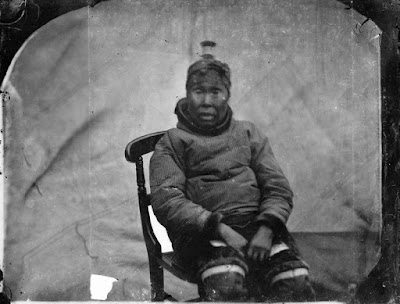
They say a mother's love can heal all wounds, but how can a mother heal her own heart after losing a child? Thirty years ago today, my precious son Ailaq was born, a beautiful and inquisitive boy who made my life a whirlwind of happiness and joy. Ailaq was truly the most loving son a mother could ask for and grew into a brave and kind young man who cared for me and his sister upon the death of my husband. Ailaq stood in sharp contrast to the lazy, no-good man my daughter married against my wishes, a man named Papik. Yet Ailaq tried to guide his brother-in-law, even taking him hunting despite the fact that, while Ailaq himself was a brilliant hunter, Papik was an incompetent one and never caught a single animal. My son's catches sustained us all, including the ungrateful Papik who grew increasingly jealous of Ailaq's skill and popularity in our village. One day, after a long day of hunting, Papik returned without Ailaq. He denied any knowledge of where my son was and furio...

Reading Notes: Inuit Folk Tales, Part B

Image
For this week, I chose to read Inuit Folk Tales from  Eskimo Folk-Tales  by Knud Rasmussenwith illustrations by native Inuit artists (1921). My favorite story from this part of the reading was Papik, Who Killed His Wife's Brother which I though was extremely interesting and intriguing. Papik, Who Killed His Wife's Brother: Papik and his brother-in-law Ailaq go out hunting together often, with Ailaq always returning with something and Papik returning with nothing. Papik grows jealous of Ailaq and kills him while they are out one day, returning without him. Ailaq's mother accuses Papik of killing her son and swears to take revenge on Papik. She dies after deliberately drowning herself in the tides and Papik lives in fear of her spirit, but cannot escape it in the end. While out with some other men, a thick fog descends and the two other men hear the screams of Papik as the spirit monster of Ailaq's mother attacks, mutilates, and kills him. These men and a large gro...

Reading Notes: Inuit Folk Tales, Part A

Image
For this week, I chose to read Inuit Folk Tales from Eskimo Folk-Tales by Knud Rasmussenwith illustrations by native Inuit artists (1921).  My favorite story from this part was The Woman Who Had a Bear as a Foster-Son  as I found this story touching and engaging. The Woman Who Had a Bear as a Foster-Son: A mother bear is killed and her cub is given to an old woman to raise. The old woman raises the bear and trains it to understand human speech and to act like a human. He is taught to take care when playing with children (and adults) and to help the hunters catch animals for food. The bear is almost killed by another group of hunters who mistake him for a normal bear, so he is made a collar in order to distinguish him from other bears. Members of other groups vow to kill the bear, but he manages to stay safe, his foster-mother always reminding him to not harm humans unless they attack him. One day, the bear brings home a dead man, presumably because the man attacked him, ...

Week 9 Story: Paid Back in Kind

Image
One beautiful summer day, a rich merchant decided to take a trip across a nearby lake, hoping to enjoy the gorgeous beach on the other side. Upon reaching the edge of the lake, he spotted three men in tattered clothing hanging out by the only boat in sight. He approached them and inquired whether he would be able to pay them to take him across the lake and then back again in a few hours, to which all three of the men readily agreed, none of them being in a position to pass up a chance to earn a few coins. So the four men set off, the rich merchant trying desperately to protect his fine clothing from the dirty bottom of the boat and wishing that he had gone ahead and bought the fine vessel his wife had pointed out to him the week before. Halfway across the lake, the men heard a giant tearing sound and bubbling as water began to fill the small boat--they had hit a mostly sunken rock and were sinking quickly. All four men panicked as none knew how to swim, and the rich merchant's ro...

Reading Notes: Tibetan Folktales, Part B

Image
For this week's readings, I chose Tibetan Folktales as seen in Tibetan Folk Tales by A. L. Shelton with illustrations by Mildred Bryant (1925). My favorite story out of those listed for Part B was How the Raven Saved the Hunter . I found it incredibly touching and sad how the hunter tried to kill the very thing that was trying to save him. How the Raven Saved the Hunter: A hunter is thirsty and makes a cup from a leaf. He attempts to drink water from a local stream but a raven flies down and knocks the cup out of his hands. This happens three times before the hunter decides to kill the raven. He shoots it down, killing it, and then decides to explore the source of the water. He finds that the water is coming out of the gaping mouth of a huge snake and that tons of animals have died from drinking the water, their bones accumulating on the side of the stream. The hunter then regrets killing the raven that was only trying to save him. In my retelling, the story will be told fro...